
Looking Up: London Architectural Details & Photography Tips
London architecture photography becomes much more interesting when you stop trying to fit every entire building into the frame and start paying attention to the details most people walk past.
Look above eye level
Use repeating patterns
Search the stonework
Watch for reflections
Photograph entrances
Use overcast light
How Do You Photograph London’s Architecture Beyond Famous Landmarks?
Slow down, look above eye level and concentrate on individual details rather than trying to fit an entire building into every frame.
Repeating arches, carved stonework, decorative entrances, ironwork and reflections can produce some of the most distinctive photographs you bring home from London.
When most visitors think about photographing London, their minds immediately jump to Big Ben, Tower Bridge, Buckingham Palace or St. Paul’s Cathedral.
Those landmarks deserve the attention they receive.
But during my first afternoon walking through London, I discovered something equally rewarding: the architectural details hiding on nearly every street.
Visit London’s London architecture guide shows just how varied the city’s buildings are, from medieval and Gothic landmarks to Victorian, Art Deco, Brutalist and contemporary architecture.
London Architecture Photography at a Glance
Why Is London So Good for Architecture Photography?
London is especially rewarding for architecture photography because centuries of different architectural styles sit side by side throughout the city.
You can encounter historic churches, Victorian commercial buildings, grand civic architecture, Georgian terraces and contemporary glass structures within a relatively short walk.
That variety creates opportunities not only for wide photographs of famous buildings but also for small studies of craftsmanship, ornament, texture and shape.
The V&A Architecture Collection is another useful resource if London’s buildings spark a deeper interest in architecture and design.
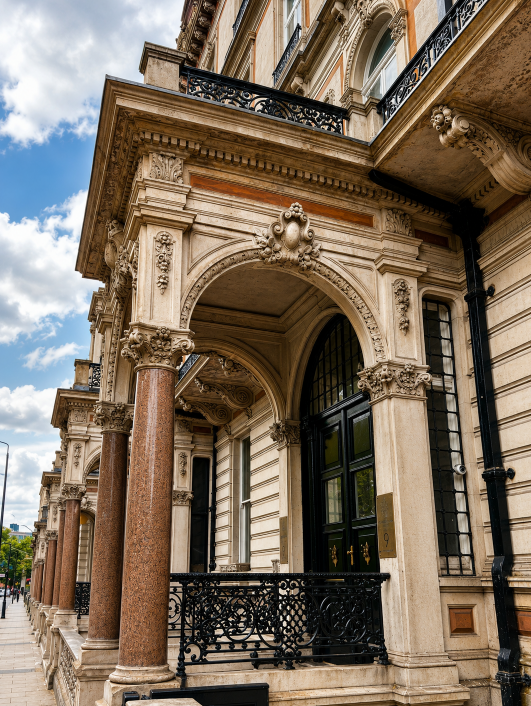
Small architectural details can become strong subjects without the building needing to be a famous attraction.
London’s Best Photography Subjects Are Often in the Details
Some of London’s most interesting photographs can come from details that most pedestrians barely notice.
One of the most enjoyable parts of photographing London is that great images don’t require famous landmarks.
Many of my favorite photographs from the day came from simply wandering the streets and paying attention to things people were walking past.
Stonework, ironwork, decorative façades, window frames, balconies and sculptural elements can all become subjects on their own.
Look Up for Hidden Architectural Details
One of the easiest ways to improve your London architecture photography is simply to look above eye level.
Most visitors naturally focus on what is directly in front of them.
Photographers should deliberately scan upward.
Some of London’s most impressive details appear above shopfronts and doorways—decorative cornices, sculpted stonework, carved capitals, balconies, pediments and ornamental ironwork.
Simply raising your camera can reveal details that completely change the story of a building.
If you enjoy this kind of detail, the V&A has an Architectural Wonders trail highlighting terracotta sculpture, façades and decorative features around the museum buildings.
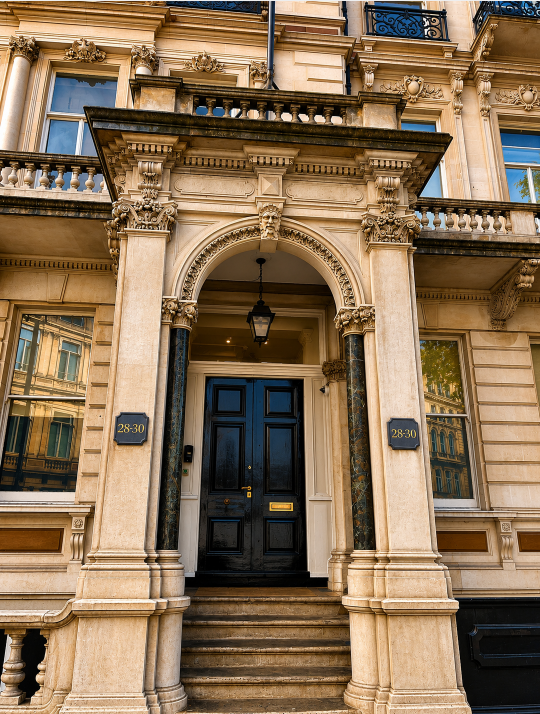
Details high above street level are easy to miss unless you deliberately scan upward.
Use Repeating Patterns to Create Strong Compositions
Repeating architectural elements create natural rhythm, depth and visual direction in photographs.
Architecture is full of repetition.
Columns, arches, railings, windows and decorative trim often repeat across a façade or along a walkway.
Instead of photographing the entire building, isolate these repeating elements and let them guide the viewer’s eye through the frame.
One of my favorite photographs from this walk came from a series of repeating arches that created depth and perspective.
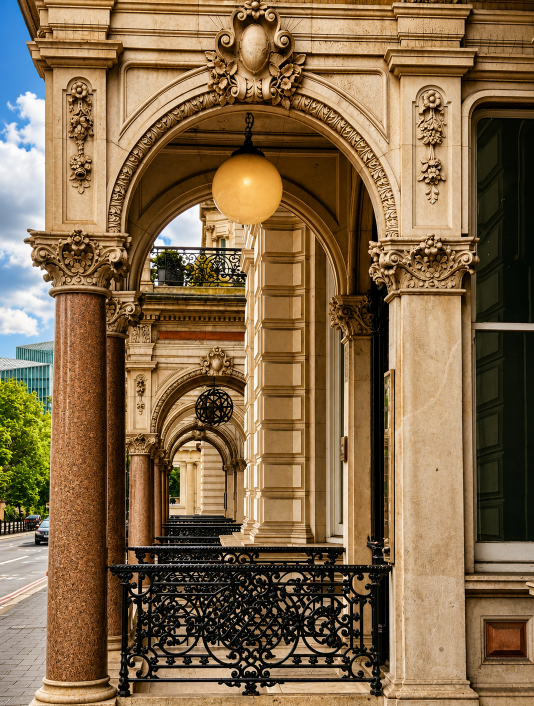
Repeating arches naturally pull the eye through the frame and create a strong sense of depth.
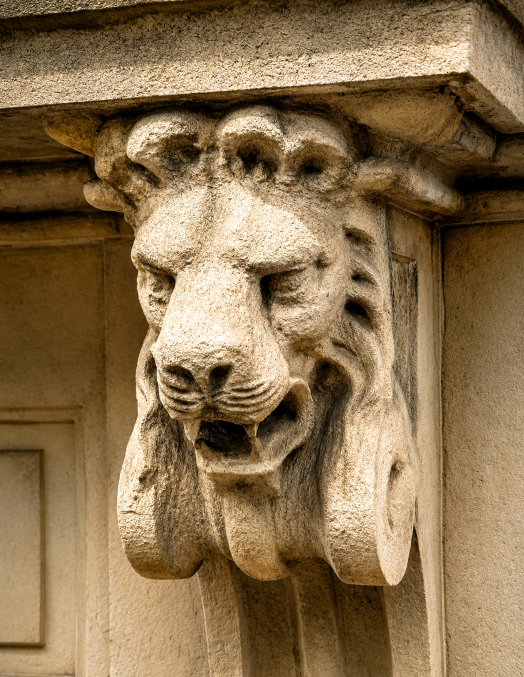
Faces, animals and symbolic carvings can turn a small section of stonework into a complete subject.
Search for Unexpected Subjects in the Stonework
Faces, animals, shields, plants and symbolic figures can turn ordinary-looking façades into surprisingly interesting photography subjects.
Many historic buildings contain decorative sculptures and carvings that are easy to miss when you’re concentrating on the entire structure.
Faces, animals, shields, floral patterns and mythological figures may appear around windows, under arches, above doors or near rooflines.
These details reveal another layer of craftsmanship and can sometimes tell you something about a building’s period, purpose or decorative programme.
Use Reflections to Photograph London Differently
Window reflections can layer old and new London together in a single photograph.
One of the most overlooked opportunities in urban photography is reflection.
Windows can transform a simple building into a layered composition that combines multiple structures in one frame.
Instead of always photographing a building directly, look at nearby windows to see whether they reflect neighboring architecture, street details or the sky.
Change your position slightly and watch how the reflected image moves across the glass.
A few steps can completely alter the composition.
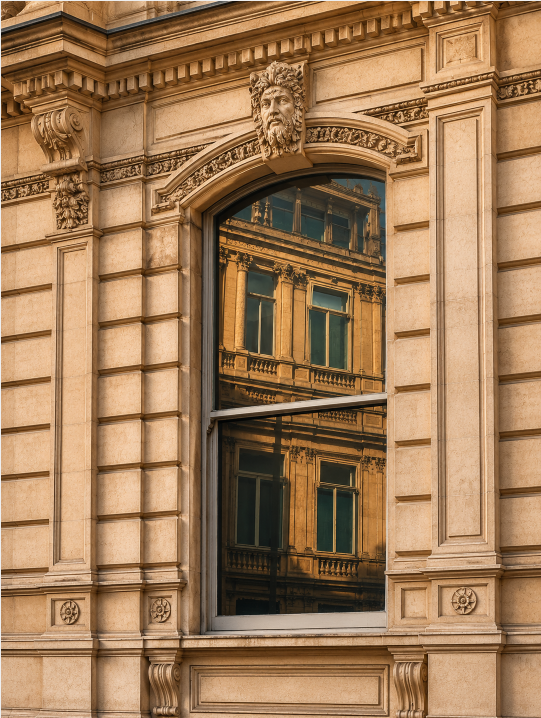
Reflections can place old and new architecture into the same frame without requiring a complicated setup.
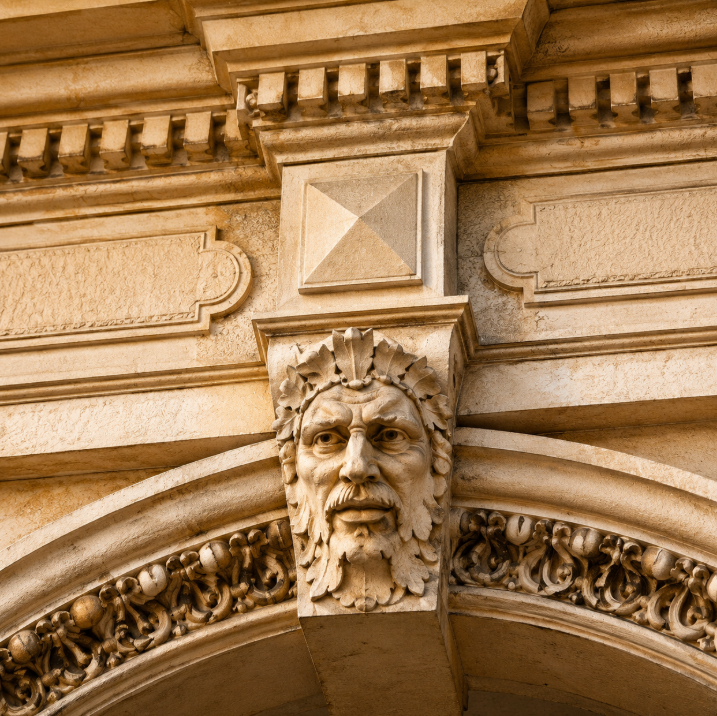
Historic entrances often combine several architectural details within one compact composition.
Photograph Entrances and Doorways
If you only have time to photograph one detail on a historic building, look closely at its entrance.
Architects and designers often gave particular attention to entrances because they shape a visitor’s first impression.
Doorways may combine carved stone, columns, pediments, arches, ironwork, decorative glass, lettering and other elements within one relatively compact area.
The doorway also creates a natural focal point, making it easier to build a balanced composition than when photographing an entire large façade.
Don’t Avoid London’s Overcast Weather
Overcast conditions can be excellent for architectural detail photography because soft light reduces deep shadows and glare.
Many photographers hope for bright blue skies, but London’s clouds can actually be an advantage when your subject is stone, brick, carvings or decorative detail.
Soft, diffused light can reveal texture while reducing the extreme contrast that strong midday sunlight creates.
The cloudy spring weather during my walk helped preserve details that might have disappeared into stronger highlights and shadows.
Do You Need a Professional Camera for London Architecture Photography?
No. You can photograph London’s architectural details successfully with a smartphone, compact camera or interchangeable-lens camera.
What matters most is noticing the subject and composing it carefully.
A smartphone is particularly useful because it allows you to react quickly when you spot an interesting carving, reflection or doorway while walking.
If your phone or camera has a telephoto or zoom option, it can also help isolate details high above street level without forcing you to crop heavily afterward.
How Do You Avoid Distorted Buildings in London Photos?
Keep the camera as level as possible when photographing façades and step farther back when space allows.
Pointing a camera sharply upward can cause vertical lines to appear as though they are leaning toward one another.
That distortion can sometimes work creatively, particularly when emphasizing height.
If you want straighter architectural lines, move back and keep the camera closer to level.
For detail photographs, distortion is often less noticeable because you’re isolating smaller sections of a building rather than showing the entire façade.
What Architectural Details Should You Look for in London?
Start with windows, doors, stone carvings, balconies, ironwork, columns, arches, rooflines and repeated decorative patterns.
Where Can You See Interesting Architecture in London?
You don’t need a dedicated architecture itinerary to find worthwhile subjects in London.
Historic and contemporary details appear throughout Westminster, Kensington, Covent Garden, the City of London and many other central neighborhoods.
Even when your destination is a major attraction such as Westminster Abbey, Buckingham Palace or the Tower of London, pay attention to the streets connecting those landmarks.
Visit London’s architecture guide is useful if you want to deliberately seek out notable buildings.
For broader trip planning, my First-Time London Travel Guide brings together my firsthand London experiences, attractions and practical planning information.
London Architecture Photography FAQ
What is the best way to photograph London architecture?
Photograph both the overall building and smaller details. Look above eye level for carvings, balconies and roofline decoration, then move closer to isolate repeating patterns, windows and entrances.
Is cloudy weather good for architecture photography?
Yes. Overcast conditions provide softer light that can reduce harsh shadows and help reveal texture in stone, brick and decorative details.
Can you photograph London architecture with a smartphone?
Yes. Smartphones work especially well for travel architecture because they are quick to use and often include wide, standard and telephoto focal lengths.
What details should you photograph on historic buildings?
Look for decorative stonework, faces, animals, crests, floral patterns, windows, balconies, iron railings, entrances, arches, columns and roofline details.
How do you photograph tall buildings without distortion?
Move farther away when possible and keep the camera more level. Tilting sharply upward exaggerates converging vertical lines.
Where should first-time visitors photograph architecture in London?
Westminster, Kensington, Covent Garden and the City of London all offer dense concentrations of historic and contemporary architecture, but worthwhile details can appear on almost any London street.
Do you need to visit famous landmarks for good London photos?
No. Some of the most distinctive photographs can come from ordinary streets, entrances, carvings, reflections and architectural details that are not famous attractions at all.
Look Closer, Not Just Wider
London’s architectural beauty isn’t limited to museums, palaces and world-famous landmarks.
It is woven into everyday buildings, hidden in decorative carvings, reflected in old and new windows, and waiting above eye level for anyone willing to notice.
Some of my favorite photographs from the city weren’t planned at all.
They happened because I slowed down, looked closer and let the details tell the story.
For photographers, that’s one of London’s greatest gifts.
Build Architecture Photography Into Your London Trip
About Angela
Angela Addington is the travel photographer and writer behind Lenses & Latitudes. She shares firsthand destination guidance and practical photography advice for independent and solo travelers, women over 50, road-trippers and weekend explorers. Learn more about Angela.
Pingback: Car Show Photography Tips: How to Capture Standout Photos
Pingback: Grace Cathedral Doors: A 1983 San Francisco Throwback
Pingback: How to Post Vacation Photos on Instagram Like a Pro