
Tsukiji Fish Market in 1995: Photographing a Piece of Tokyo History
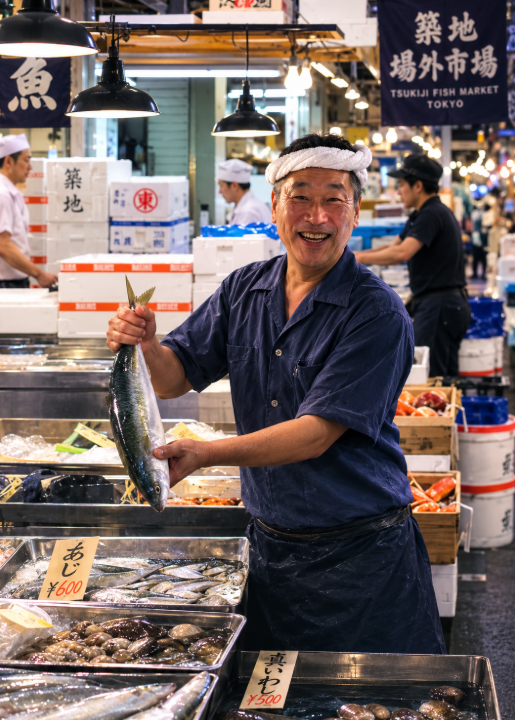
In 1995, I walked through Tokyo’s working Tsukiji Fish Market with a camera. One fishmonger stopped, proudly held up a fish for me—and gave me a photograph that means even more now than it did then.
Why Does This Old Tsukiji Photograph Matter?
Because I thought I was photographing one person during an ordinary travel moment. Decades later, I realized I had also photographed a working market that would eventually disappear in that form.
Tokyo in 1995 was my first international trip.
I was walking through Tsukiji Fish Market with my camera, surrounded by seafood, boxes, workers and the energy of a place built for business rather than tourists.
Then one fishmonger noticed the camera.
He picked up a fish and proudly held it toward me.
I pressed the shutter.
I never learned his name. I do not know what became of him after that morning.
But more than three decades later, that photograph still takes me directly back to Tokyo.
Historical context: My photographs were made inside Tsukiji’s working market in 1995. The inner wholesale market closed in 2018 and wholesale operations moved to Toyosu. The separate Tsukiji Outer Market remains active today.
Tsukiji Across Three Decades
This Was Never Just a Tourist Attraction
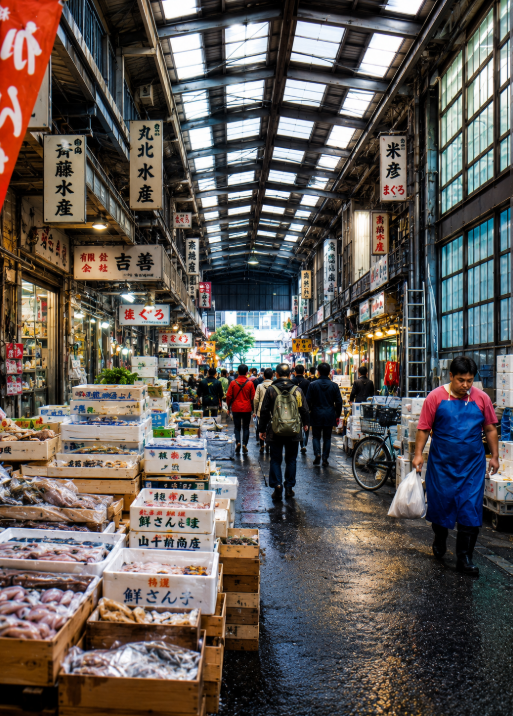
The thing I remember most is that Tsukiji felt like a workplace first and a place for visitors second.
By the time I visited in 1995, Tsukiji had already been operating for about six decades.
Restaurants, retailers and professional buyers depended on the market.
The stacked boxes, seafood displays, hanging lights and workers moving through the aisles were not staged for photographs.
That is one reason these old images matter to me.
They show Tsukiji doing what Tsukiji was built to do.
What Happened to the Old Tsukiji Fish Market?
The inner wholesale market closed in October 2018, and its major wholesale operations moved to the new Toyosu Market.
For decades, Tsukiji became internationally famous for seafood trading and its tuna auctions.
But the aging facility was eventually replaced by a modern wholesale complex in Toyosu.
That means the working environment I photographed in 1995 no longer exists at Tsukiji in quite the same way.
That realization changed the way I looked at these photographs.
They were no longer simply souvenirs from my first trip overseas.
They had become small historical records.
Can You Still Visit Tsukiji?
Yes. The Tsukiji Outer Market is still active and remains a major food destination in Tokyo.
The Outer Market includes food shops, seafood sellers, restaurants, kitchenware businesses and other specialty vendors.
For first-time visitors, the official market recommends visiting during the morning and generally suggests the 9 a.m.–2 p.m. period for shopping.
Professional buyers have priority before 9 a.m., and individual business hours vary.
The market’s information center, Plat Tsukiji, provides maps and visitor assistance.
Would I Photograph Tsukiji Differently Now?
Absolutely—and the biggest difference would be asking before photographing people or shops.
The official Tsukiji visitor guidelines now explicitly ask visitors to get permission from shopkeepers before taking photographs.
Some individual businesses prohibit photography altogether.
The guidelines also ask visitors not to block professional buyers, not to wander while eating, and to move through the narrow market streets in small groups.
If I return with my camera, those rules would shape how I photograph the market today.
Why Old Travel Photographs Become More Valuable With Time
Places Change
A market, building, streetscape or business may look ordinary when you photograph it and become historically important decades later.
People Matter
The fishmonger is what gives this photograph life. He turned a picture of a market into a human memory.
You Change Too
The photographer who looks at the image decades later sees details and meaning the original photographer never considered.
Would I Return to Tsukiji?
Yes—but I would not go back expecting to recreate 1995.
I would want to photograph what Tsukiji has become.
I would take the old images with me and look for visual connections between the market I remember and the Outer Market that remains today.
I would also visit Toyosu to better understand where the wholesale side of the story went next.
The goal would not be to pretend nothing changed.
The change is the story.
My First International Trip Began in Tokyo
Tsukiji is one of several memories that survived from that 1995 trip through photographs.
Another is Ueno Zoo, where an old photograph has become its own then-and-now story.
Read: Ueno Zoo Then and Now — My First International Trip →
For more stories about the way old photographs preserve changing destinations, see Alcatraz Then and Now.
And for practical advice on making stronger travel images today, visit my Travel Photography Tips.
Tsukiji Fish Market FAQ
When did the original Tsukiji wholesale market close?
The inner wholesale market closed in October 2018, and major wholesale operations moved to Toyosu Market.
Is Tsukiji Fish Market still open?
The old inner wholesale market is no longer operating at Tsukiji, but the Tsukiji Outer Market remains open with food shops, restaurants and specialty businesses.
What time should visitors go to Tsukiji today?
The official market recommends visiting during the morning, with roughly 9 a.m. to 2 p.m. being a useful general window. Individual shop hours vary.
Can you take photographs at Tsukiji?
Photography rules vary by shop. The official visitor guidelines ask travelers to get permission from shopkeepers before taking pictures and to respect any posted photography restrictions.
When did you visit Tsukiji Fish Market?
I visited in 1995 during my first international trip, more than two decades before the inner wholesale market moved to Toyosu.
I Thought I Was Taking a Vacation Photograph
What I actually brought home was a tiny piece of Tokyo history.
That is one of the reasons I keep returning to old travel photographs.
The meaning of an image does not necessarily end when you press the shutter.
Places change. People move on. Entire markets relocate.
And thirty-one years later, that fishmonger is still standing there in my photograph, proudly holding up his fish.
About Angela
Angela Addington is the travel photographer and writer behind Lenses & Latitudes. She shares firsthand destination guidance and practical photography advice for independent and solo travelers, women over 50, road-trippers and weekend explorers. Learn more about Angela.
Pingback: Alcatraz Then and Now: My View 42 Years Later - Lenses and Latitudes