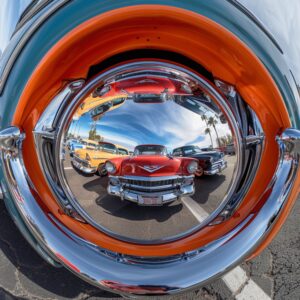
A polished hubcap turns surrounding classic cars into a creative reflection rather than another standard full-car photograph.
Capturing the Magic: Photography Tips for Car Shows
Car shows offer polished paint, chrome, distinctive details and plenty of personality—but reflections, crowds and tightly parked vehicles can make strong photographs harder than they look.
My approach: photograph the whole vehicle, then slow down and look again for reflections, details, cleaner backgrounds and interactions that tell more of the story.
How Do You Take Better Photos at a Car Show?
Arrive early when crowds are lighter, photograph each car from several angles, watch reflections in paint and chrome, simplify the background, capture both full-car views and small details, and adjust exposure so bright highlights retain texture.
Car shows look easy to photograph because beautiful vehicles are already lined up in front of you.
But that convenience creates its own problems.
Cars may be parked close together. Spectators walk through backgrounds. Chrome reflects everything. Bright paint can lose detail in direct sunlight.
The strongest results usually come from slowing down rather than moving quickly from one car to the next.
Car Show Photography at a Glance
Plan Your Car Show Photography Before You Arrive
A little preparation can make the difference between rushed snapshots and a stronger collection of photographs.
Check the event schedule, parking, weather forecast and photography rules before leaving home.
Make sure your camera or phone is charged and that you have enough storage space.
If you use a camera, consider packing an extra battery, memory card, microfiber cloth and circular polarizing filter.
Arriving near opening time can help. Smaller crowds may make it easier to photograph complete vehicles without people continually crossing the frame.
Chrome details can become both subject and framing device when you stop looking only for full-car photographs.
Use Reflections to Create Something More Interesting
Hubcaps, mirrors, polished paint and chrome can show the surrounding car show in ways a direct photograph cannot.
Rows of closely parked vehicles can quickly begin to look repetitive.
Instead of photographing every car from standing eye level, move closer to reflective details and see what appears inside them.
Shift left or right and watch how the reflection changes.
Before pressing the shutter, check carefully for your own reflection, distracting visitors or clutter you did not intend to include.
Photograph the Details That Give Each Car Character
A full-car photograph documents the vehicle. The details often explain why that particular vehicle caught your attention.
Look for hood ornaments, emblems, headlights, grilles, wheels, steering wheels, stitching, dashboard controls and unusual body lines.
Fill the frame with one clear subject.
Move closer rather than relying heavily on digital zoom.
If your phone offers a true macro mode, it can be useful for especially small details.
Otherwise, stay within the phone’s minimum focusing distance and crop afterward if necessary.
Control Harsh Light and Reflections
Chrome, glass and polished paint reflect almost everything around them, so light becomes one of the biggest technical challenges at a car show.
When possible, photograph earlier or later in the day when sunlight is softer.
During brighter midday conditions, look for cars in open shade or change your position until harsh glare becomes less distracting.
Watch chrome and light-colored paint carefully so bright areas retain texture.
On a smartphone, tap near the brightest important area and lower the exposure slightly when highlights appear washed out.
Polarizer tip: A circular polarizing filter can reduce glare and deepen color, but it can also remove reflections you actually want. Rotate it while looking through the viewfinder and choose the effect intentionally.
Separate the Car From a Crowded Background
People, tents, signs and neighboring vehicles can easily compete with the car you are trying to photograph.
Before taking the picture, look beyond the vehicle.
Sometimes moving only a few feet to one side can remove a distracting sign or place a cleaner area behind the car.
For detail photographs, a wider aperture can soften the background.
For a complete vehicle, step back and use a longer focal length when space allows rather than photographing extremely close with a very wide lens.
Do Not Photograph Every Car the Same Way
A strong car-show collection should feel like a visual story rather than a catalog of identical three-quarter views.
Full-Car View
Begin with a clean view that documents the vehicle and its overall design.
Front or Rear Detail
Headlights, grilles, taillights and badges often reveal distinctive styling.
Low Angle
Lowering the camera can emphasize body lines, wheels and the stance of the vehicle.
Reflection
Use chrome, mirrors and polished surfaces to incorporate surrounding cars or show atmosphere.
Interior Detail
Steering wheels, gauges, stitching and dashboards can add variety—when access is permitted.
Event Atmosphere
Finish with a wide photograph or candid interaction that places the vehicle inside the larger event.
Quick Camera Settings for Car Shows
f/5.6–f/8
Use Aperture Priority as a practical starting point when you want most or all of a stationary vehicle sharp.
f/2.8–f/5.6
A wider aperture can isolate emblems, lights and details while softening a busy background.
1/250 sec+
Use at least 1/250 second for walking visitors and 1/500 second or faster when vehicles are moving.
ISO: Keep it as low as the available light reasonably allows. Use single-point autofocus for stationary details and continuous autofocus for moving subjects.
Car Show Photography With Your Phone
You do not need a DSLR or mirrorless camera to create strong car-show photographs.
Clean the phone lens before you begin.
Use the standard camera for strong overall image quality.
Tap the car or detail you want sharp.
If chrome or bright paint dominates the exposure, lower it slightly before making the photograph.
Portrait mode can sometimes work for close details, but inspect the result carefully. Artificial blur may distort mirrors, antennas or curved body edges.
Use Burst mode or Live Photos for people, demonstrations or moving vehicles when available.
Photograph the People and Atmosphere Too
The cars may be the reason people attend, but the people help explain what the event actually felt like.
Look for owners discussing their vehicles, visitors studying engine compartments, judges inspecting cars and vendors displaying memorabilia.
Make at least one wider establishing photograph showing the scale and setting of the show.
Be respectful when including recognizable people.
Ask permission before making close portraits and before photographing inside a privately owned vehicle.
Edit the Photograph Without Changing the Car
Editing should improve the photograph while preserving the true color and character of the vehicle.
Start with exposure, white balance, contrast and highlights.
Recover bright reflections carefully and open shadows when important details disappear.
Moderate sharpening can help chrome, emblems and body lines stand out.
Avoid aggressive saturation or filters that substantially change the actual paint color.
When editing documentary or editorial coverage, authenticity matters more than making the car look artificially dramatic.
Reflections Can Become Part of the Composition
Chrome, mirrors and polished paint offer some of the best opportunities at a car show to experiment with creative viewpoint.
For more ideas, read Reflecting on Perspective: Finding the Unexpected Through the Lens.
Common Car Show Photography Mistakes
Shooting Every Car From Standing Height
Change camera height and angle so the entire collection does not look repetitive.
Ignoring Reflections
Check paint, chrome and glass for yourself, spectators and unwanted clutter before pressing the shutter.
Blowing Out Chrome Highlights
Lower exposure when necessary so bright areas retain visible texture.
Accepting a Cluttered Background
Move a few feet whenever possible before deciding that a distracting tent, sign or person must remain.
Photographing Only Complete Cars
Details often reveal craftsmanship and personality more effectively than another full-body photograph.
Using Too Much Digital Zoom
Move closer when appropriate or crop afterward rather than sacrificing image quality.
Overediting Paint Color
Do not make a red car orange or a subtle metallic finish unnaturally saturated.
Forgetting Event Etiquette
Respect vehicles, owners, barriers and event photography rules.
Quick Car Show Photography Checklist
Car Show Photography FAQ
What is the best time to photograph a car show?
Near opening time is often useful because crowds may be lighter and early light may be softer. The exact conditions depend on the event location and schedule.
What aperture should I use for car photography?
For an entire stationary car, f/5.6 to f/8 is a practical starting point. For close details where you want a softer background, try approximately f/2.8 to f/5.6.
How do you reduce reflections on cars?
Change your shooting position, work in softer light when possible and consider a circular polarizing filter. Remember that some reflections may actually strengthen the composition, so do not automatically remove them all.
How do you photograph cars in a crowded show?
Arrive early, move around the vehicle to search for cleaner backgrounds, photograph tight details when the entire car cannot be isolated and wait for brief openings in pedestrian traffic.
Can you take good car show photos with a smartphone?
Yes. Use the standard lens, tap to focus, lower exposure when bright reflections wash out and physically change your position rather than depending heavily on digital zoom.
What details should I photograph at a car show?
Look for hood ornaments, emblems, wheels, headlights, grilles, mirrors, steering wheels, dashboard controls, stitching and distinctive design lines.
Should you use a polarizing filter for car photography?
A circular polarizer can reduce glare and deepen colors, but it can also remove interesting reflections. Rotate it while viewing the scene and choose the amount of polarization that supports the photograph.
How much should you edit car show photos?
Correct exposure, white balance and distracting highlights while keeping the car’s actual color and finish believable. Avoid heavy filters and excessive saturation.
Build Stronger Travel Photography Skills
Car shows combine several useful photography challenges: reflective surfaces, crowds, details, changing light and visual storytelling.
For broader guidance on composition, lighting, focus, smartphones and photographing different situations while traveling, visit my complete Travel Photography Tips guide.
Photograph More Than the Car
The best car-show photograph is not always the cleanest full-car view.
Make that photograph first.
Then look closer.
Notice what appears in the chrome. Study the hood ornament. Change your height. Wait for the background to clear. Watch an owner explaining the car to someone who genuinely wants to know its story.
Those details and interactions are what turn a collection of parked vehicles into a photographic story.
Slow down enough to photograph the character of the show, not just the cars lined up inside it.
About Angela
Angela Addington is the travel photographer and writer behind Lenses & Latitudes. She shares firsthand destination guidance and practical photography advice for independent and solo travelers, women over 50, road-trippers and weekend explorers. Learn more about Angela.